Enterprise leaders don’t have time to read ten scattered articles just to understand where AI, cloud, and automation are heading. If you searched for Droven.io Enterprise Tech Innovation, you may be trying to understand what Droven.io is, what the phrase means, and how enterprise technology innovation applies to modern businesses.
The distinction is important: Droven.io is a technology and AI-focused content platform, while enterprise technology innovation is a broader concept covering how businesses use technologies such as AI, cloud computing, data analytics, cybersecurity, and automation.
This guide explains the connection between the two and looks at how enterprises can approach technology innovation in practical terms.
Table of Contents
What Is Droven.io Enterprise Tech Innovation?
Droven.io Enterprise Tech Innovation is best understood as the intersection of Droven.io’s technology-focused content and the broader concept of enterprise technology innovation.
Droven.io covers topics related to AI, emerging technologies, software development, digital transformation, startups, and future technology. Enterprise technology innovation, meanwhile, refers to the way organizations adopt and integrate technology to improve operations, solve business problems, manage risk, and create new opportunities.
The phrase should therefore not automatically be interpreted as the name of a specific SaaS product or enterprise software platform.
Is Droven.io a Software Product or a Content Platform?
This is one of the most important distinctions.
Droven.io is not a SaaS tool that enterprises log into to run automations, connect business systems, or process operational data. It functions as a technology-focused editorial and information resource.
That matters because someone searching for Droven.io Enterprise Tech Innovation may initially expect to find pricing, product features, integrations, or a demo page.
Instead, Droven.io is more useful as an information and research layer for understanding technology trends and concepts before evaluating specific enterprise products or vendors.
What Is Known About Droven.io?
Droven.io presents itself as a technology and AI-focused website covering areas such as artificial intelligence, machine learning, generative AI, software development, startups, emerging technology, and digital transformation.
That makes it useful for researching technology concepts and staying familiar with developments across the industry.
However, it is important to distinguish information about Droven.io itself from the broader enterprise technology concepts discussed in its content. Droven.io should not automatically be treated as an enterprise software vendor, implementation platform, or formal consulting framework unless a specific source establishes that role.
Why Enterprise Tech Innovation Matters in 2026
Enterprise technology has shifted from a simple “which tool should we buy?” conversation toward a more difficult question: how do we prove that technology is producing measurable value?
Two areas are particularly important.
The AI Adoption vs. ROI Gap
Many organizations are experimenting with or deploying generative AI across business functions. The harder challenge is turning individual pilots into reliable systems that produce measurable financial or operational results.
This creates an adoption-to-value gap. Deploying an AI system is only the beginning. Enterprises also need appropriate data, governance, workflow integration, monitoring, and clearly defined success metrics.
The practical lesson is simple: an AI initiative should be connected to a business outcome rather than measured only by how many tools or models have been deployed.
Workforce and Skill-Gap Pressure
Technology transformation also creates workforce challenges.
As AI and automation change how employees work, organizations need to consider role redesign, training, upskilling, and change management alongside technology deployment.
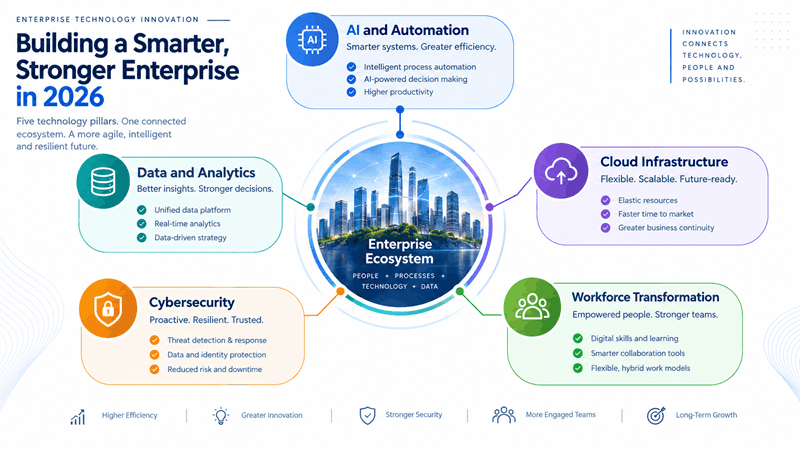
Enterprise innovation is therefore not purely a technology problem. It involves people, processes, data, infrastructure, and governance working together.
Who Should Use Droven.io Enterprise Tech Innovation?
Who Can Benefit From It?
- CIOs and CTOs aligning AI, cloud, cybersecurity, and data strategy
- IT managers evaluating infrastructure modernization and cloud migration
- Digital transformation leaders connecting technology investments to workflow improvements
- Founders and business leaders moving from startup-stage tools toward scalable operating systems
- Operations and security teams researching automation, resilience, governance, and digital trust
When It May Not Be the Right Resource
If you’re looking for a specific SaaS product review, pricing comparison, vendor shortlist, or detailed implementation proposal, general Droven.io enterprise technology content won’t replace vendor-specific research.
It is better treated as an information and education layer that helps you understand the technology landscape before making a purchase or implementation decision.
What Are the Core Pillars of Enterprise Tech Innovation?
AI and Intelligent Automation
AI is moving beyond isolated experiments into workflows involving customer support, software development, document processing, research, and decision support.
The important challenge is operationalization. Enterprises need repeatable processes, monitoring, human oversight, and clear rules around where AI should and should not be used.
Data and Analytics
AI systems depend heavily on the quality of the data behind them.
Enterprises with inconsistent, duplicated, or siloed data can struggle to produce reliable analytics and AI outputs. Modernization therefore increasingly involves connecting data sources and improving data quality before expanding AI use cases.
Hybrid Cloud and Scalable Infrastructure
Hybrid cloud combines public cloud, private infrastructure, and on-premises systems.
For enterprises, this approach can provide flexibility around cost, compliance, latency, workload requirements, and data residency. The appropriate architecture depends on the organization’s applications, regulatory requirements, and operational needs.
Cybersecurity and Digital Trust
Technology expansion also expands the attack surface.
Enterprise innovation therefore needs identity management, access controls, security monitoring, governance, and risk management from the beginning rather than treating security as a later project.
Workforce Transformation
Technology rollouts can struggle when employees are not prepared to use new systems.
Workforce transformation includes training, role redesign, change management, and defining where human judgment remains necessary alongside automated systems.
Traditional Automation vs. AI-Driven Automation
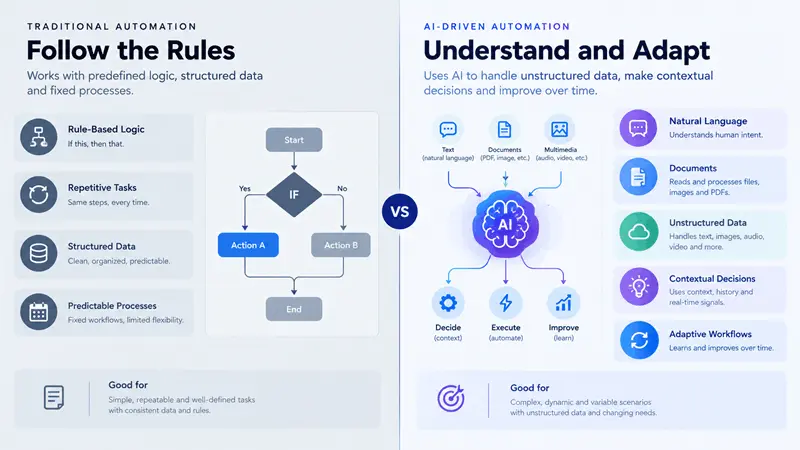
| Feature | Traditional Automation | AI-Driven Automation |
|---|---|---|
| Logic type | Fixed if/then rules | Adaptive, context-aware decisions |
| Unstructured data | Limited | Can process text, documents, and natural language |
| Maintenance | Requires updates when inputs change | Can handle greater variation |
| Setup complexity | Usually simpler | Usually more complex |
| Best for | Predictable repetitive tasks | Tasks involving ambiguity or variability |
| Example | Auto-forwarding emails by subject | Categorizing support tickets by intent |
| Cost pattern | Lower initial complexity | Higher initial investment |
The practical takeaway: traditional automation remains useful for simple, predictable workflows. AI-driven automation becomes more valuable when a process involves language, judgment, or unstructured information.
Not every workflow needs AI.
Traditional Enterprise IT vs. Enterprise Tech Innovation
| Area | Traditional Approach | Enterprise Tech Innovation Approach |
|---|---|---|
| AI | Isolated pilots | Integrated workflows tied to business outcomes |
| Data | Siloed reporting | Connected analytics and decision systems |
| Cloud | Partial migration | Architecture aligned with workload needs |
| Security | Reactive controls | Built-in identity, governance, and risk management |
| Workforce | Static roles | Upskilling and human-AI collaboration |
The main difference is not simply using newer technology. It is connecting technology decisions to business requirements and measurable outcomes.
How Enterprise Software Integrates With AI Platforms
Enterprise AI integration is rarely a plug-and-play process. Most implementations rely on several common mechanisms.
API Connections
CRMs, ERPs, ticketing platforms, and other enterprise systems often expose APIs that allow AI applications to access or exchange data.
Webhooks and Event Triggers
Webhooks can send real-time signals when an event occurs, such as a new customer request, support ticket, lead, or inventory update.
Middleware and Orchestration Layers
Middleware can sit between existing enterprise systems and AI services, helping translate data formats, manage workflows, and coordinate system interactions.
In practice, integration and workflow design can be as important as choosing the underlying AI model.
Real-World Examples of Enterprise Tech Innovation
Retail
AI-assisted demand forecasting, inventory planning, and promotion optimization.
Healthcare
Patient-flow analytics, scheduling, operational visibility, and resource planning.
Manufacturing
Predictive maintenance, connected equipment monitoring, and automated quality control.
Finance
Fraud detection, anomaly monitoring, risk analysis, and cloud security.
Human Resources
Workforce planning, skills analysis, hiring support, and employee development.
These examples show that enterprise technology innovation is not limited to one industry or one type of software.
How to Evaluate Enterprise AI Tools
Start With the Business Problem
Define the business problem before choosing a technology. If the workflow itself is unclear, adding AI will not solve the underlying issue.
Audit Your Data Readiness
Check whether the required data is accurate, accessible, secure, and sufficiently structured for the intended use case.
Understand AI Failure Modes
Don’t evaluate an AI system only by its successful outputs. Understand what happens when it produces an incorrect result or encounters an unexpected input.
Run a Focused Pilot
A limited pilot can reveal integration, usability, security, and performance problems before a large-scale rollout.
Budget for Ongoing Maintenance
AI systems require monitoring, evaluation, updates, and operational support. These costs should be included in the business case from the beginning.
How to Measure Enterprise Tech Innovation Success
Technology initiatives should have measurable outcomes before they are scaled.
| KPI Category | What It Measures | Why It Matters |
|---|---|---|
| Process Cycle Time | Workflow speed | Measures efficiency |
| Cost per Workflow | Cost of completing a task | Tracks operational expense |
| Incident Reduction | System or security issues | Measures reliability |
| Employee Productivity | Output relative to resources | Evaluates operational impact |
| Customer Response Time | Service speed | Measures customer experience |
| Revenue Lift | Financial contribution | Helps evaluate business value |
A useful measurement approach is to connect each major innovation initiative to at least one operational metric, one financial metric, and one quality or risk metric.
Step-by-Step Enterprise Technology Strategy
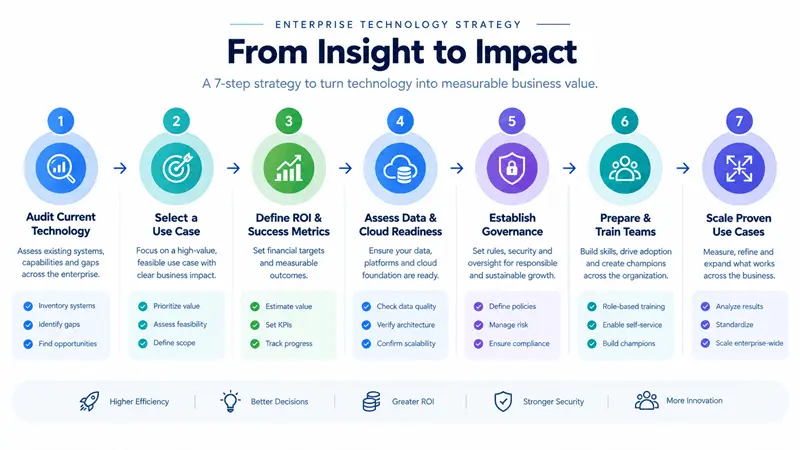
1. Audit Your Current Technology
Identify existing systems, infrastructure, data sources, and technology gaps.
2. Select a Specific Use Case
Choose a focused business problem rather than attempting a broad transformation immediately.
3. Define ROI and Success Metrics
Establish measurable business and operational outcomes before implementation.
4. Assess Data and Cloud Readiness
Review data quality, accessibility, security, infrastructure, and cloud requirements.
5. Establish Governance
Define security, privacy, access, compliance, monitoring, and responsible-use requirements.
6. Prepare and Train Your Teams
Give employees the training and support required to adopt new systems effectively.
7. Scale Proven Use Cases
Expand initiatives only after technical performance, adoption, and business value have been demonstrated.
This approach helps organizations avoid scaling a technology initiative before its technical and business assumptions have been tested.
Common Enterprise Technology Mistakes to Avoid
- Adopting AI without a clearly defined business goal
- Ignoring legacy system integration challenges
- Treating cloud migration as a simple lift-and-shift exercise
- Delaying cybersecurity planning
- Underestimating employee training and change management
- Scaling pilots before they are stable
- Chasing technology trends without governance
- Measuring activity instead of business outcomes
How to Use Droven.io for Enterprise Technology Research
Droven.io can be useful as an initial research resource for understanding technology topics, emerging trends, and terminology.
For example, a technology leader might use editorial content to understand a concept before moving to vendor documentation, technical specifications, security assessments, or implementation research.
That distinction is important. Editorial technology content can help frame a problem and identify questions to investigate, but it should not replace primary documentation or due diligence when an organization is evaluating a real enterprise technology investment.
Final Thoughts on Droven.io Enterprise Tech Innovation
Droven.io Enterprise Tech Innovation is best understood by separating the two ideas within the phrase.
Droven.io is a technology and AI-focused content platform, while enterprise technology innovation describes the broader process of using technology to improve business operations, decision-making, security, efficiency, and growth.
For enterprises, the important part is not simply adopting AI, cloud, or automation. Technology investments need to connect to measurable business outcomes, reliable data, appropriate governance, workforce readiness, and sustainable implementation.
Key Takeaways
- Enterprise innovation is about outcomes, not tool counts.
- AI initiatives should connect to measurable business objectives.
- Cloud, data, and cybersecurity should be considered together.
- Workforce readiness is an important part of technology transformation.
- Editorial resources can help with research but should not replace technical due diligence.
- Disciplined implementation is more useful than adopting technology simply because it is new.
Droven.io Enterprise Tech Innovation FAQs
Droven.io provides technology-focused information that can help readers understand areas such as AI, emerging technology, software development, and digital transformation. Enterprise technology innovation itself can support business growth when technology investments are connected to measurable improvements in efficiency, customer experience, risk management, or revenue.
The underlying principles of enterprise technology innovation can also apply to smaller organizations. Clear use cases, data readiness, phased implementation, and measurable outcomes are useful regardless of company size, although the technology and governance requirements may differ.
Common areas include artificial intelligence, machine learning, generative AI, cloud computing, data analytics, cybersecurity, DevOps, workflow automation, and other emerging technologies.
Start by identifying a specific business problem, reviewing existing systems and data, selecting a focused use case, defining success metrics, and establishing governance before scaling the initiative.
Droven.io is publicly accessible as a technology-focused content website. Readers can access its published information without treating it as a paid enterprise software platform.
Droven.io presents itself as a technology and AI-focused editorial resource. Specific commercial relationships or affiliations should be verified directly when evaluating any particular technology or vendor claim.
No. Editorial content can help organizations understand concepts and prepare questions, but complex enterprise implementations may require technical specialists, consultants, security teams, or implementation partners.
Leave a Reply