
Table of Contents
Ask someone to name an English word that starts with X. You’ll probably hear “xylophone,” followed by a long pause. Most dictionaries give the letter just a few pages.
Science is another story. Doctors order X-rays every day, plants pull water up through their xylem, and somewhere in a lab right now, a chemist is working with xenon.
So we dug through textbooks, glossaries, and NASA’s own pages and pulled together 60+ science words that start with X. Each one gets a short, simple meaning and a fact or two to help it stick. You’ll know some of them already. Others (xanthophore, anyone?) might be brand new.
Quick List: 10 Science Words That Start With X
If you only learn ten, make it these. They come up again and again in school science, on tests, and in the news.
| Word | Field | Simple Meaning |
| X-ray | Physics | Light you can’t see that passes through skin but not bone |
| Xenon | Chemistry | A rare noble gas, element 54 |
| Xylem | Biology | The tubes that carry water up a plant |
| X chromosome | Genetics | One of the two human sex chromosomes |
| Xerophyte | Botany | A plant made for dry places, like a cactus |
| X-axis | Math and physics | The side-to-side line on a graph |
| Xenolith | Geology | A piece of foreign rock stuck inside another rock |
| Xanthophyll | Biology | The yellow pigment in leaves |
| Xerography | Technology | The dry copying method inside photocopiers |
| Xenobiotic | Biochemistry | A chemical the body doesn’t make, like a drug or pesticide |
Why Do So Many Science Words Start With X?
Here’s a shortcut most textbooks skip. Nearly every X word in science is Greek. When naturalists in the 1700s and 1800s needed names for new things, they reached for Greek roots, and a handful of those roots happen to begin with X.
Learn these five, and you can decode a surprising number of words on sight:
- Xeno- comes from xenos, meaning “foreign” or “stranger.” That’s how xenon got its name: it was the stranger gas hiding in the air.
- Xero- means “dry.” A xerophyte is a plant built for dry ground.
- Xylo- is “wood.” Think of xylem, the plant tissue that turns into wood in trees.
- Xantho- means “yellow,” as in xanthophyll, the color you see in fall leaves.
- Xiph- is the odd one out. It means “sword,” and you’ll find it in the xiphoid process at the bottom of your breastbone.

Five Greek roots unlock the meaning of most X science words.
And X-ray? That one breaks the pattern. When Wilhelm Röntgen found these mysterious rays in 1895, he had no idea what they were. So he did what any math student does with an unknown and called it X. The name stuck.
Words That Start With X in Physical Science
Physical science is the study of nonliving things: matter, energy, motion, and the forces that push them around. It covers physics and chemistry, and most schools fold Earth and space science in too.
Need a physical science word that starts with X? You have more choices than you might think. X-ray is the obvious pick, but keep reading.
Physics Words That Start With X
X-ray is the big one. NASA describes X-rays as light with wavelengths of roughly 0.03 to 3 nanometers. That’s far shorter than the light our eyes can see, so X-rays carry enough energy to slip through skin and muscle. Bone stops more of them, which is why it shows up white on a scan.
A whole group of physics terms grows out of that one word:
- An X-ray tube makes the rays. It fires electrons at a metal target, and the target gives off X-rays when they hit.
- Every element gives off its own pattern of X-ray energies, called its X-ray spectrum. Scientists use it like a fingerprint.
- X-ray diffraction (XRD) bounces X-rays off a crystal. The way they scatter tells you how the atoms inside are stacked.
- With X-ray fluorescence (XRF), the sample answers back with its own “signature” X-rays, so you can tell which elements it holds.
- The X unit is a tiny, old-fashioned length (about 0.1 picometer). Early X-ray researchers used it before modern units took over.
A few physics words have nothing to do with X-rays at all:
- X-axis. The horizontal line on any graph. In physics class, time usually goes here.
- X-band covers microwave frequencies from about 8 to 12 gigahertz. Weather radar uses it. So does the police officer checking your speed, and so do NASA’s deep-space radio links.
- Xi baryon sounds like a sci-fi villain, but it’s a subatomic particle made of three quarks. The common versions hold two “strange” quarks (yes, that’s the real name).
- Xenon-135 is a radioactive form of xenon that soaks up neutrons. Nuclear reactor operators watch it closely because it can choke a chain reaction.
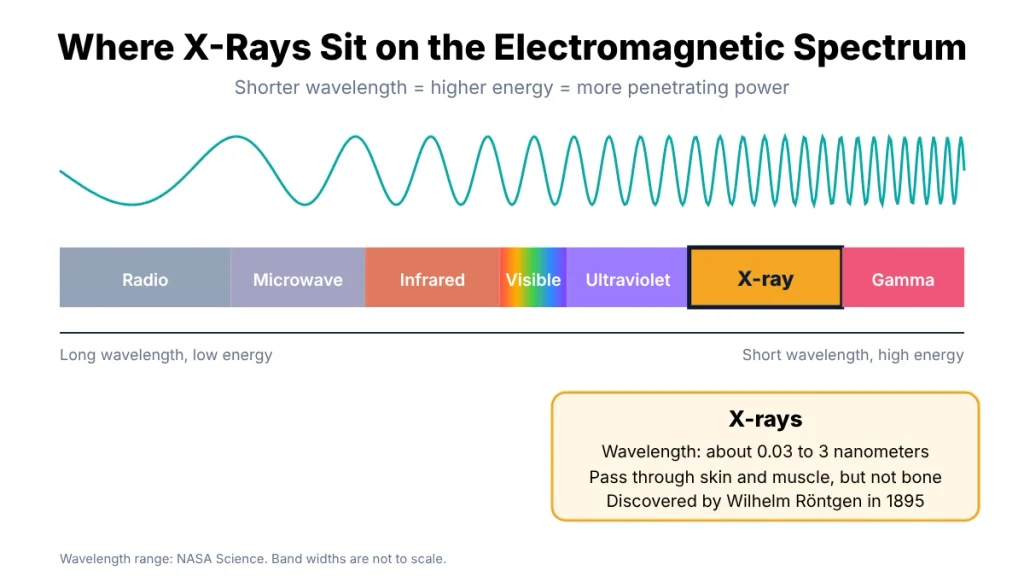
X-rays sit between ultraviolet light and gamma rays on the electromagnetic spectrum.
Fun fact: Röntgen’s discovery earned him the very first Nobel Prize in Physics, awarded in 1901.
Chemistry Words That Start With X
Chemistry has exactly one element that starts with X, and it’s a good one.
Xenon (Xe) is element 54, a heavy noble gas. There isn’t much of it around. It makes up less than 0.1 parts per million of the air you breathe. William Ramsay and Morris Travers found it in 1898 while studying liquefied air, and they named it after the Greek word for “stranger.” Today it lights up lamps and even pushes spacecraft (more on that below).
For decades, chemists believed noble gases never reacted with anything. That idea fell apart in 1962, when researchers made the first noble gas compounds. Xenon difluoride (XeF₂), a white solid, was one of them.
The rest of the chemistry list is a mixed bag. You might have a few of these in your kitchen right now:
| Word | What It Is | Where You’ll Find It |
| Xylitol | A sugar alcohol from birch wood and fruit | Sugar-free gum and mints (it’s toxic to dogs, so keep it away from pets) |
| Xanthan gum | A thickener made when bacteria ferment sugar | Salad dressing, sauces, and gluten-free bread |
| Xylene | A sweet-smelling liquid made from petroleum | Paint thinner, ink, and one of the raw materials for PET soda bottles |
| Xylose | A simple sugar, often called “wood sugar” | Plant cell walls |
| Xanthine | A natural compound found in body tissues | Its chemical cousins include caffeine and theobromine, the stimulant in chocolate |
| Xanthate | A salt that contains sulfur | Mines, where it helps separate metal ore from waste rock |
| Xerogel | A gel that has dried and shrunk into a solid | The silica gel packets in new shoe boxes |
One more: chemists write a plain capital X as shorthand for any halogen, such as fluorine, chlorine, bromine, or iodine, in general formulas like R–X.
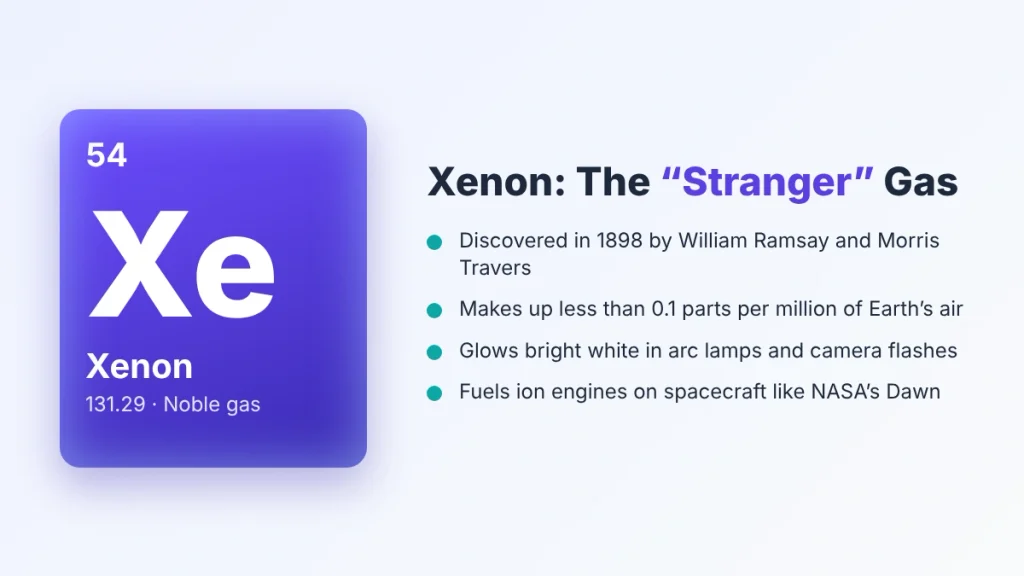
Xenon is the only element on the periodic table that starts with X.
Earth Science Words That Start With X
Geology has some of the coolest X words, mostly thanks to that “xeno” root.
A xenolith is a chunk of foreign rock stuck inside igneous rock. As magma rises, it tears pieces off the rock around it and then cools with those pieces locked inside. Some xenoliths come all the way up from Earth’s mantle. That gives geologists samples from depths no drill has ever reached.
- Xenocryst: the same idea on a smaller scale. It’s one foreign crystal instead of a whole chunk of rock.
- Xenomorphic mineral grains never got to grow their own flat faces, because neighboring crystals crowded them out.
- Xenotime is a yellowish-brown mineral packed with yttrium. That makes it a useful source of the rare earth elements found in electronics.
- Scientists call very dry places, like deserts and sun-baked ridges, xeric. If a place is hot and dry at the same time, the word is xerothermic.
Space Science Words That Start With X
Here’s the catch with X-ray astronomy. Earth’s atmosphere blocks X-rays, which protects us but also means telescopes have to go to space to see them.
- X-ray astronomy studies the hottest, most violent things in the universe, from exploding stars to matter spiraling into black holes.
- NASA launched the Chandra X-ray Observatory on July 23, 1999. According to the Chandra X-ray Center, it has photographed exploded stars, galaxy clusters, and the areas around black holes.
- Europe’s XMM-Newton went up the same year, and it’s still working.
- An X-ray binary is a pair of stars in which a black hole or neutron star steals gas from its partner. That gas heats up to millions of degrees and blasts out X-rays. The illustration below shows how it works.
- X-class flares are the strongest kind of solar flare. A big one can scramble radio signals and GPS here on Earth.
- Xenon ion propulsion is how NASA’s Dawn spacecraft got around. It carried 425 kilograms of xenon and used electric ion engines to visit the asteroid Vesta and the dwarf planet Ceres. The push was gentle, but the engines were incredibly fuel-efficient.
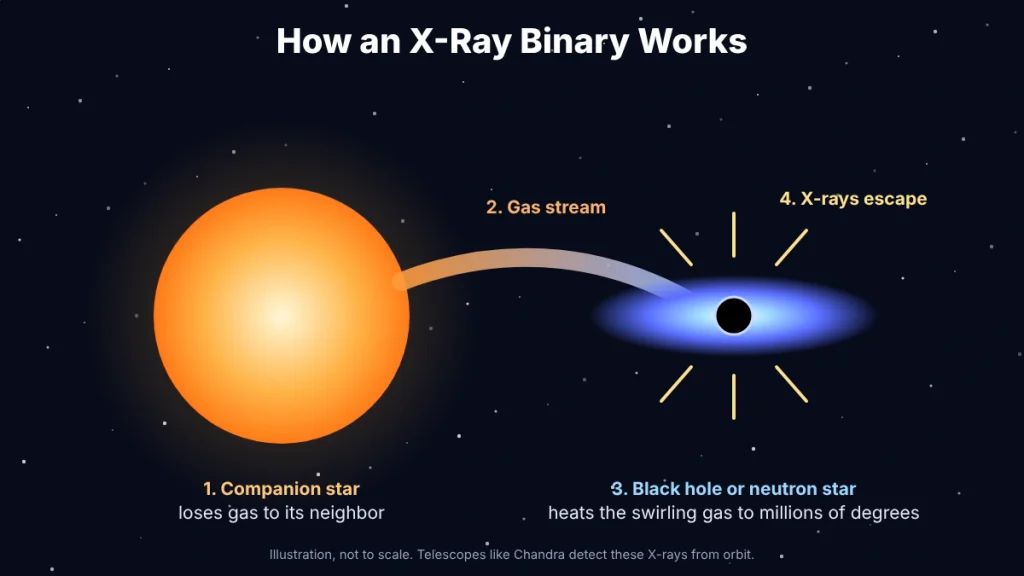
In an X-ray binary, superheated gas around a black hole or neutron star gives off X-rays.
Biology Words That Start With X
Biology probably has more X words than any other field. Plants alone account for a bunch of them.
- Xylem is a plant’s plumbing. It carries water and minerals up from the roots, and only up. In trees, old xylem becomes the wood we build with.
- A xerophyte is a plant built for drought. Cacti are the classic example: thick stems store water, and spines take the place of leaves so less moisture escapes.
- Xanthophyll is the yellow pigment in leaves. It’s there all summer, hidden under green chlorophyll. Once the chlorophyll breaks down in autumn, the yellow finally shows.
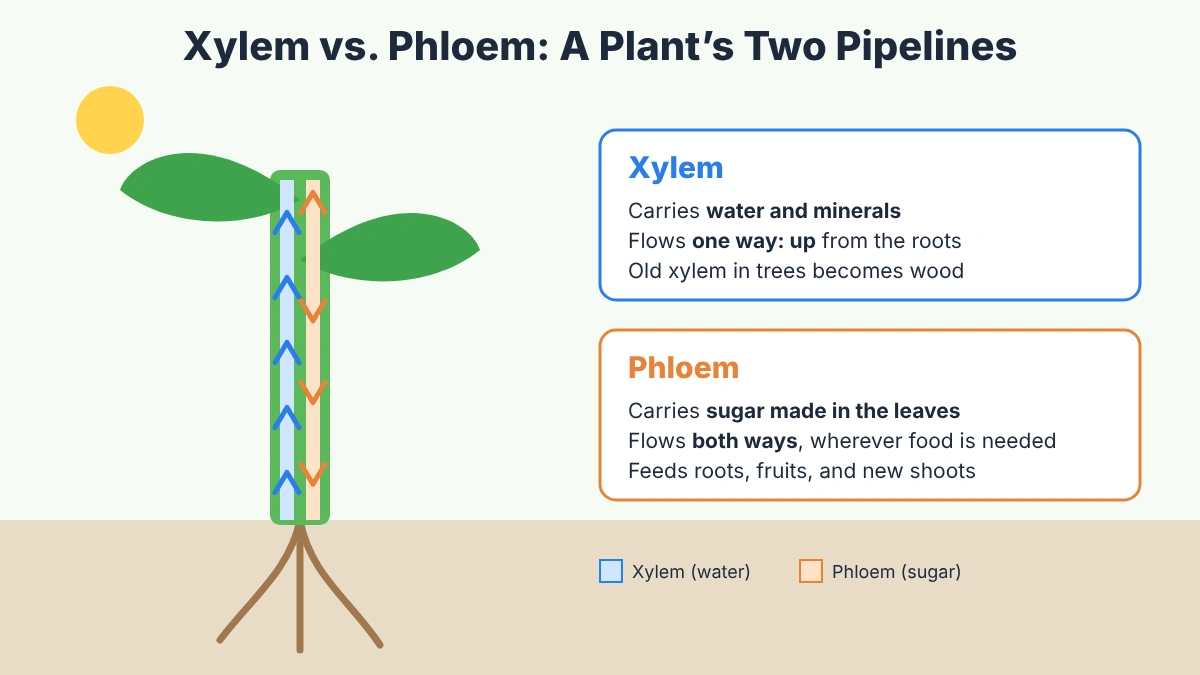
Xylem moves water up from the roots, while phloem moves sugar from the leaves.
Genetics adds two important ones.
The X chromosome is one of the two sex chromosomes. Most females have two X’s, and most males have one X and one Y. It carries about 900 genes, according to the National Human Genome Research Institute. The Y is far smaller.
Since males have just one X, a faulty gene there has no backup copy. That’s why X-linked traits like red-green color blindness and hemophilia show up much more often in boys and men.
The rest of the biology list covers animals, microbes, and a few tongue twisters:
- Xenograft: tissue moved from one species into another. Pig heart valves used in human heart surgery are a common example.
- Xenopus is the African clawed frog. Labs love it because its eggs are big and easy to work with.
- Xanthomonas bacteria cause spots and blights on crops. One species also makes xanthan gum, the same thickener that’s in your salad dressing.
- Xanthophores are pigment cells. They’re behind the yellows and oranges on many fish, frogs, and reptiles.
- Termites are xylophagous, which is a fancy way to say they eat wood.
- A xerophile loves dryness. Some molds, for example, can grow on jam and dried fruit, where most microbes can’t.
- Xenogamy means cross-pollination between flowers on two different plants of the same species.
- Xerosere describes how life slowly takes over bare rock: lichens come first, then mosses, grasses, shrubs, and finally trees.
- Xenobiotic covers any chemical your body doesn’t make on its own, including medicines, pesticides, and pollutants. Your liver handles most of the cleanup.
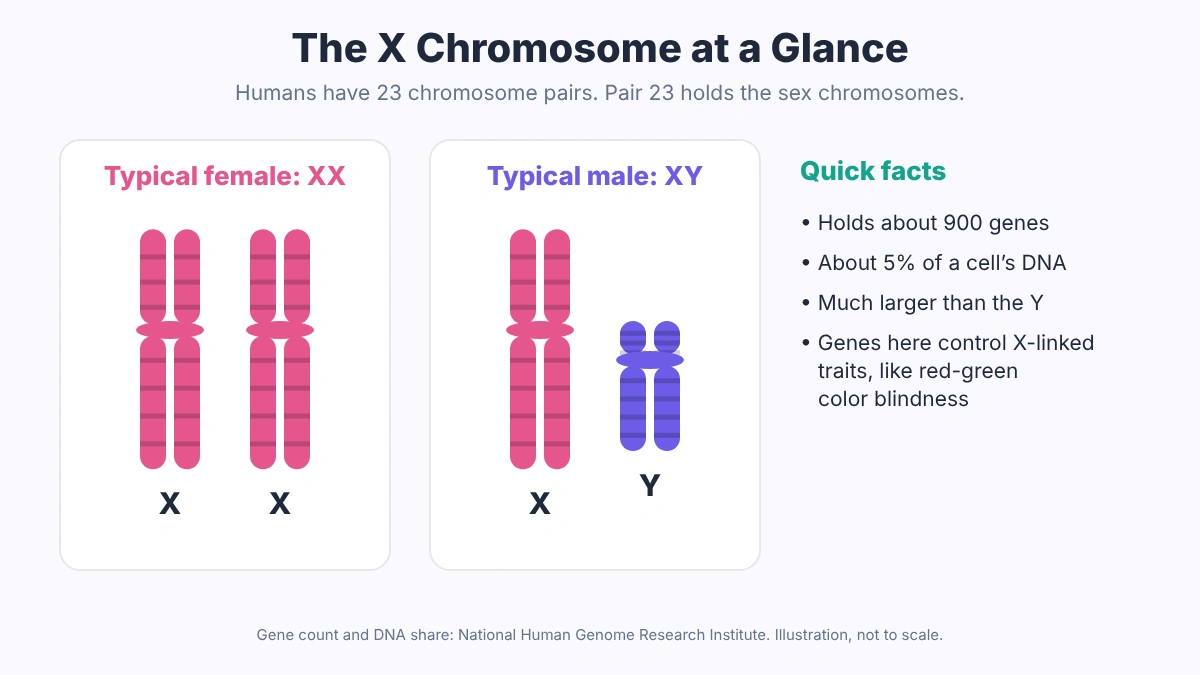
The X chromosome is much larger than the Y and carries about 900 genes.
Medical and Health Words That Start With X
Most medical X words begin with “xero.” That makes sense, since a lot of health problems involve something drying out.
| Term | What It Means |
| Xerostomia | Ongoing dry mouth, often caused by medicines or radiation therapy |
| Xerosis | Abnormally dry skin |
| Xerophthalmia | Severe eye dryness caused by a lack of vitamin A |
| Xeroderma pigmentosum | A rare inherited condition in which the body can’t repair sun damage to DNA |
| Xanthoma | A yellowish, fatty bump under the skin, often linked to high cholesterol |
| Xiphoid process | The small, sword-shaped tip at the bottom of the breastbone |
Two of these deserve a closer look. Xerophthalmia matters worldwide, because the World Health Organization calls vitamin A deficiency a leading cause of preventable blindness in children. And if you’ve ever taken a CPR class, you were probably told to keep your hands above the xiphoid process.
Then there’s X-ray imaging, also called radiography. It’s still one of the quickest ways to check for a broken bone, pneumonia, or a cavity. Xenotransplantation, meaning the transfer of animal organs or tissue into people, made headlines in 2022. That year, surgeons at the University of Maryland transplanted a pig heart into a living patient for the first time.
Technology and Applied Science Words That Start With X
- Every office copier owes something to xerography, the dry printing process Chester Carlson invented. He made the first copy in 1938, and Xerox later built its brand name on the word.
- X-ray crystallography maps molecules atom by atom. Rosalind Franklin’s famous X-ray image, “Photo 51,” helped scientists work out DNA’s double helix in 1953.
- Xenon arc lamps send electricity through xenon gas and give off a bright, daylight-like glow. Cinema projectors depend on them.
- Chipmakers have tested X-ray lithography as a way to print ultra-fine circuit patterns onto silicon.
- An XRF analyzer is a handheld gadget that uses X-ray fluorescence to show what’s in a sample. Inspectors point it at paint, toys, and soil to look for lead.
- Xeriscaping is gardening with drought-tolerant plants. It’s popular across the dry American Southwest, where every gallon of water counts.
Easy Science Words That Start With X for Kids
Teaching younger kids? Skip the jargon and start here:
- X-ray: light you can’t see that shows the bones inside you
- Xylem: a plant’s drinking straw
- Xenon: a gas that glows super bright in special lamps
- Xerophyte: a plant that likes it dry, like a cactus
- X-axis: the side-to-side line on a graph
- Xylophagous: wood-eating (termites!)
- Xeric: really, really dry
Classroom idea: Bring in a xylophone. It isn’t a science word, but its name literally means “wood sound,” and kids can hear how the shorter bars make higher notes because they vibrate faster.
Commonly Confused Science Words That Start With X
Students mix up these pairs all the time.
- Xylem vs. phloem. Xylem carries water up. Phloem carries sugar from the leaves to wherever the plant needs food, so it can flow up or down.
- Xerosis vs. xerostomia. Both mean “dry.” The first is about skin, the second about the mouth.
- Xenolith vs. xenocryst. A whole chunk of foreign rock versus a single foreign crystal.
- X-rays vs. gamma rays. Both are high-energy light. What separates them is where they come from: X-rays usually come from electrons, and gamma rays come from an atom’s nucleus.
Easy Tips to Remember Science Words That Start With X
Memorizing a list of strange words is hard. These tricks make it easier.
- Start with the roots. Once you know xeno, xero, xylo, and xantho, half the list explains itself.
- Picture something. A cactus for xerophyte. A straw for xylem. Silly pictures work best.
- Stick to one subject at a time instead of jumping between physics and biology.
- Make flashcards with the word on one side and a real example on the other. Lots of students snap photos of their cards. If yours ever disappear, our guide on how to recover lost photos on Windows can help.
- Turn the list into a quiz app. A no-code tool like the Lovable AI app builder lets you build one for your class without writing any code.
- Write your own sentences. “The xerophyte survived the drought” will stay with you far longer than a definition you read once.
FAQs About Science Words That Start With X
What is a physical science word that starts with X?
X-ray is the one most people know. Xenon, X-ray diffraction, X-band, xenolith, and X-ray binary all work too.
Which element starts with the letter X?
Just one: xenon (Xe), atomic number 54. It’s a noble gas, and there’s only a trace of it in the air.
What does the X in X-ray stand for?
“Unknown.” Wilhelm Röntgen borrowed the algebra symbol because he didn’t know what kind of rays he had found.
What are some biology words that start with X?
Start with xylem, xerophyte, xanthophyll, the X chromosome, and xenobiotic. Those five cover most school biology.
How many science words start with X?
Hundreds, if you count every technical term. This guide sticks to the 60+ that students and curious readers are most likely to come across.
The Short Version
X may be a lonely letter in everyday English, but science keeps it busy. It names the rays that let doctors see inside us, the gas that carried Dawn through the asteroid belt, and the tissue that keeps every tree standing. If you remember just one thing from this list, make it the Greek roots. They turn a page of strange words into something you can figure out on your own. Bookmark this page for the next time an X word pops up on a test or in the news.
Leave a Reply