Searching for Grok NSFW prompts usually brings up the same advice: add more detail, describe the lighting, mention the camera, and keep refining the prompt.
That works to a point.
The bigger difference usually comes from how the scene is described. A prompt that tells Grok who the subject is, what they are wearing, where they are, what they are doing, and what kind of image you want gives the model a much clearer target.
There is another thing worth keeping in mind. “NSFW” is a broad term. Some people use it for a glamorous or suggestive portrait, while others mean explicit adult content. Those are not necessarily the same request, and what Grok allows can also depend on its current settings and policies.
For most image-generation work, it is more useful to describe the picture you want than to keep repeating the word “NSFW.”
Table of Contents
What Are Grok NSFW Prompts?
Grok NSFW prompts generally refers to prompts people use when creating mature, sensual, provocative, or adult-oriented images with Grok.
The problem with the term is that it does not tell the image model much by itself.
Compare:
“Make an NSFW woman.”
with:
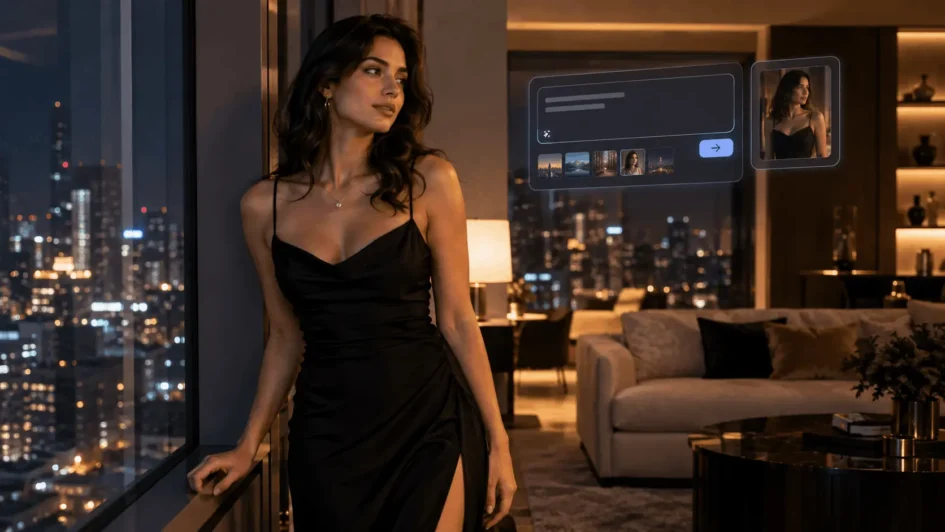
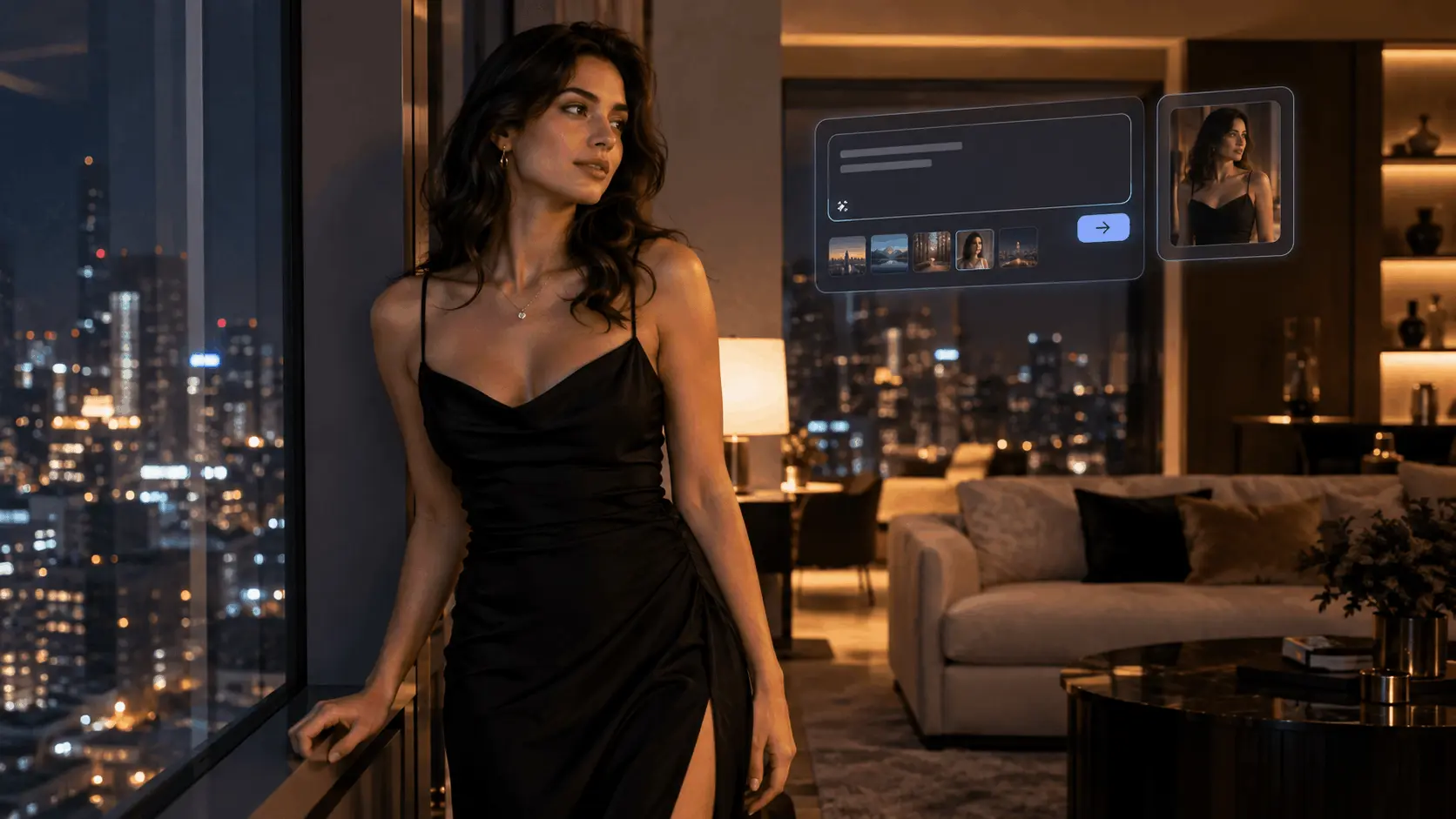
“Fictional adult woman in her late twenties, wearing an elegant black evening dress, standing beside a hotel window at night, warm interior lighting, city lights outside, realistic editorial photography.”
The second prompt gives Grok an actual scene to work with.
You have a subject, age range, clothing, location, lighting, and visual direction. Even if you later change the outfit or setting, the basic structure remains useful.
That is the real idea behind good prompt writing: describe the image instead of simply labeling it.
How to Write NSFW Prompts for Grok
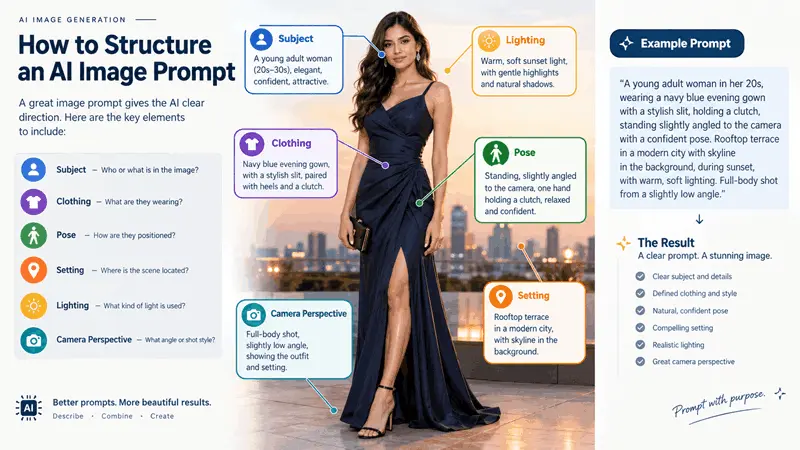
You don’t need a huge paragraph every time.
Start with the parts that matter most to the image:
- Subject: who is in the scene
- Age: make the character clearly adult
- Appearance: hair, general look, or other relevant features
- Clothing: outfit and overall style
- Pose: standing, sitting, walking, looking toward the camera, etc.
- Setting: bedroom, studio, rooftop, hotel, street, beach, and so on
- Lighting: soft window light, neon, golden hour, studio lighting
- Visual style: realistic photography, editorial, cinematic, film photography
Then stop.
Adding another ten adjectives rarely fixes a scene that is poorly described.
For instance:
“Fictional 28-year-old woman with shoulder-length dark hair, wearing a black evening dress, standing beside a large hotel window at night. Warm interior light, city skyline in the background, natural skin texture, realistic editorial photography, shallow depth of field.”
There is enough information here to establish a visual direction without turning the prompt into a wall of instructions.
A Simple Formula for Grok Imagine
A useful starting structure is:
Subject + appearance + clothing + pose + setting + lighting + visual style
You can also think of it as telling a photographer what to capture.
For example:
Adult fictional character + evening outfit + luxury apartment + standing near a window + warm lighting + cinematic portrait
From there, change individual elements.
Want a different mood? Change the lighting.
Want a different composition? Change the pose or camera perspective.
Want a different character? Change the appearance.
This makes prompt editing much easier than starting over every time.
Grok Imagine NSFW Prompts: Details That Actually Matter
When people search for Grok Imagine NSFW prompts, they often want a particular look rather than a magic combination of keywords.
Here are the details worth paying attention to.
1. Make the character clearly adult
If you are creating a fictional character, state that the character is an adult.
“A fictional 27-year-old woman” is much clearer than “a girl.”
You don’t need to repeat the character’s age throughout the prompt. Establish it once and move on to the visual details.
2. Give the scene somewhere to exist
A subject floating in an undefined environment leaves a lot for the model to invent.
Instead of:
“Adult woman posing outside.”
Try:
“Adult woman standing on a rooftop overlooking a city after sunset.”
The second version establishes depth, background, time of day, and a natural reason for the lighting.
3. Use clothing to establish the mood
Wardrobe is an easy way to change the character without changing the entire prompt.
You could use:
- black evening dress
- tailored suit
- satin blouse
- summer dress
- leather jacket
- formal evening wear
- minimalist studio fashion
The same character can feel completely different depending on the outfit and environment around her.
4. Don’t underestimate lighting
Lighting is one of the easiest ways to make an otherwise ordinary prompt more interesting.
Try:
- soft window light
- warm hotel lighting
- neon reflections
- low-key cinematic lighting
- golden-hour sunlight
- dramatic side lighting
- controlled studio lighting
For a realistic image, lighting often does more than another handful of words such as “beautiful,” “stunning,” or “ultra detailed.”
5. Decide how the camera should see the scene
If composition matters, say so.
Useful directions include:
- close-up portrait
- three-quarter portrait
- medium shot
- full-body composition
- eye-level camera
- over-the-shoulder view
- shallow depth of field
You can also mention a photographic style, such as 85mm portrait photography or fashion editorial photography, when that is relevant to the look you want.
Best NSFW Grok Prompts for Different Visual Styles
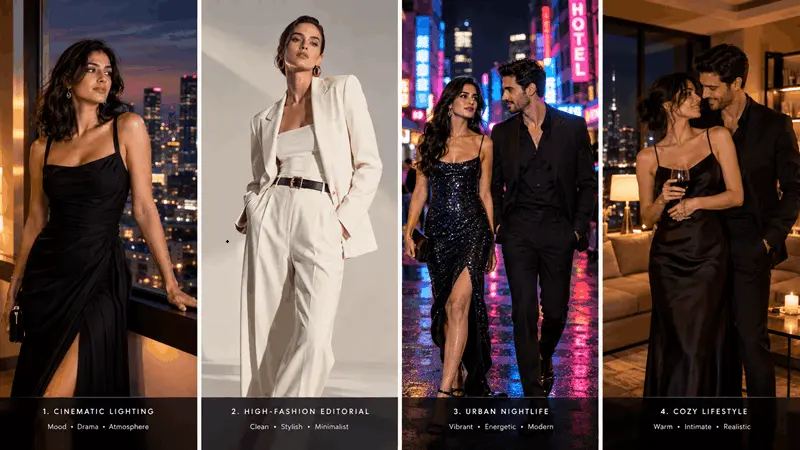
There isn’t one best NSFW Grok prompt that works for every situation.
The better approach is to start with the type of image you want and build the prompt around it.
Cinematic Portrait
“Fictional adult woman, 29 years old, wearing an elegant black evening dress, standing beside a large apartment window at night, warm practical lighting, subtle shadows, city lights in the distance, realistic skin texture, cinematic portrait photography, shallow depth of field.”
Fashion Editorial
“Fictional adult model in her late twenties wearing sophisticated evening fashion, standing in a minimalist studio, dramatic side lighting, detailed fabric texture, natural expression, high-fashion editorial photography, clean magazine composition.”
Neon City Scene
“Two fictional adults in their late twenties walking through a neon-lit city street at night, stylish evening clothing, wet pavement reflecting colorful signs, natural body language, cinematic atmosphere, realistic photography, shallow depth of field.”
Romantic Indoor Scene
“Fictional adult couple in their late twenties in a softly lit apartment, elegant evening clothing, relaxed body language, warm light coming through the window, intimate but non-explicit atmosphere, cinematic photography, natural composition.”
These examples focus on scene construction rather than trying to force a particular result with provocative keywords.
Suggested Read: Recover deleted photos
Why Some Grok Prompts Work Better Than Others
One of the easiest mistakes to make is assuming that a longer prompt must be a better prompt.
It isn’t.
Consider this:
“Beautiful, gorgeous, sexy, attractive, stunning, realistic, cinematic, highly detailed, amazing, perfect quality, 8K.”
It sounds descriptive, but it doesn’t actually tell the model much about the scene.
Now compare it with:
“Fictional 30-year-old woman wearing a dark evening dress, seated beside a hotel window after sunset, warm practical lighting, city lights in the distance, 85mm portrait photography, shallow depth of field.”
The second prompt is shorter in spirit, but much more useful.
It tells the model what the subject looks like, where she is, what she is wearing, when the scene takes place, how it is lit, and how the camera should frame it.
Specific details beat adjective stacking
Instead of:
“Beautiful, gorgeous, stunning woman.”
Try:
“Fictional 28-year-old woman with shoulder-length dark hair, wearing a black evening dress, standing beneath warm hotel lighting.”
The second description gives the model visual information rather than a collection of opinions.
A Reusable Grok Prompt Template
If you regularly create NSFW prompts for Grok, this template is a good place to start:
“A fictional adult [age]-year-old [character description], wearing [clothing], [pose/action], in [location], [lighting], [camera or visual style], realistic details, natural composition.”
For example:
“A fictional adult 31-year-old woman with short dark hair, wearing a tailored evening suit, standing beside a rooftop railing overlooking a city at dusk, soft golden-hour lighting, cinematic portrait photography, natural composition.”
The useful part of this template is that you can swap individual sections without rebuilding the whole prompt.
What to Avoid in Grok Prompts
Vague instructions
“Make it better” doesn’t give the model a useful target.
Instead, explain what needs changing:
“Use softer lighting and a closer portrait composition.”
That’s actionable.
Conflicting instructions
If you ask for a dark nightclub illuminated by bright midday sunlight, Grok has to decide which instruction matters more.
Contradictions can be useful for surreal artwork, but if you’re trying to create a realistic scene, keep the instructions compatible.
Too much prompt padding
Words such as “ultra realistic,” “hyper realistic,” “masterpiece,” “perfect quality,” and “8K” are often repeated far beyond their usefulness.
If the composition is wrong, adding more quality adjectives won’t fix it.
Describe the scene first.
Jailbreak language
Search results for Grok NSFW content often include terms such as “uncensored,” “unlocked,” or jailbreak prompts.
Those are not really prompt-writing skills.
Current Grok guidance and third-party discussions also distinguish between ordinary prompting and attempts to circumvent platform restrictions. The latter can become outdated quickly as product rules and enforcement change.
If your goal is better image generation, spend your effort on the image itself: subject, setting, clothing, lighting, framing, and style.
Can You Use Celebrity Names in Grok NSFW Prompts?
This is worth treating differently from fictional characters.
There is a significant difference between designing an adult fictional character and asking an image generator to create intimate imagery of an identifiable real person.
For a particular aesthetic, describe the characteristics instead of relying on a celebrity’s name.
For example:
“Adult woman with short blonde hair, wearing red-carpet fashion, dramatic studio lighting and a polished editorial look.”
That gives you a visual direction without making an identifiable real person the subject.
Current discussions around Grok’s image-generation restrictions specifically identify sexual imagery involving real identifiable people as a restricted category.
What If Grok Doesn’t Generate the Image You Expected?
Don’t rewrite the entire prompt immediately.
Change one thing.
If the composition looks wrong, change the camera angle or pose.
If the background is distracting, simplify the location.
If the lighting looks flat, change the light source.
If the outfit isn’t coming through properly, make the clothing description more specific.
For example, start with:
“Adult woman in an evening dress standing in a city apartment.”
Then make one controlled change:
“Adult woman in a floor-length black evening dress, standing beside a large apartment window, three-quarter portrait, city lights visible behind her.”
That small change gives you more information about what affected the result.
This is much easier to troubleshoot than replacing ten parts of the prompt at once.
Are “Uncensored” Grok Prompts Really Necessary?
Not necessarily.
The phrase “uncensored Grok prompts” gets attention because many people searching for adult-image generation are really asking how far Grok can go.
But “uncensored” is not a special prompt ingredient.
If the image you want is a sophisticated adult portrait, the important instructions are still the ordinary ones: composition, wardrobe, setting, lighting, camera perspective, and visual style.
Grok’s current product documentation and recent prompt guides also make a distinction between official adult-oriented settings and attempts to bypass restrictions. In other words, a product setting and a jailbreak prompt are not the same thing.
For prompt quality, the practical takeaway is simple: describe the image you want rather than trying to find a magic word that unlocks it.
Grok NSFW Prompts vs. Grok Imagine NSFW Prompts
The two phrases are often used interchangeably, but the search intent can be slightly different.
Someone searching Grok NSFW prompts may be interested in general prompt ideas, including text or image-related use cases.
Someone searching Grok Imagine NSFW prompts is more likely looking specifically for image-generation prompts.
That means an image-focused prompt should spend more time on things that affect the picture:
- subject
- wardrobe
- pose
- environment
- composition
- lighting
- camera perspective
- visual style
For text-based adult storytelling, those priorities would be different.
If you’re writing prompts specifically for Grok Imagine, don’t fill the prompt with instructions that only make sense for a chatbot conversation.
How to Make Your Prompts More Consistent
Once you have a prompt that produces a good result, save the parts that matter.
For example:
Character: fictional adult woman, late twenties, shoulder-length dark hair
Wardrobe: black evening dress
Location: luxury apartment
Lighting: warm window light
Composition: three-quarter portrait
Style: realistic editorial photography
Now you can change one variable at a time.
Change the apartment to a rooftop.
Change the black dress to a tailored suit.
Change warm window light to neon lighting.
Change the three-quarter portrait to a full-body composition.
This creates a small prompt system rather than a collection of random prompts.
Suggested Read: Top 5 Best Photo Recovery Tools
Final Takeaway
The useful part of Grok NSFW prompts isn’t really the word “NSFW.”
It is everything around it.
A clear subject, a believable setting, specific clothing, a defined pose, sensible lighting, and a consistent visual style give Grok far more information than a paragraph full of words such as “sexy,” “beautiful,” “ultra realistic,” and “8K.”
If you’re experimenting with NSFW prompts for Grok, start by describing the image as if you were briefing a photographer.
Then make one change at a time.
And if you’re specifically looking for Grok Imagine NSFW prompts, put most of your attention on the visual parts of the request: composition, wardrobe, environment, lighting, and camera perspective.
That approach is more useful than chasing a supposedly magic “uncensored” prompt—and it gives you a repeatable way to improve your results.
Frequently Asked Questions
There isn’t one prompt that is best for every image. A useful prompt clearly establishes the adult fictional subject, setting, clothing, pose, lighting, and visual style.
Not automatically. A short prompt with specific visual information can be more useful than a long prompt filled with generic adjectives.
You can describe fictional adult characters using realistic photographic details, subject to Grok’s current rules and settings.
No. If the scene itself is clearly described, the label may not add much useful information.
Change one variable at a time. Start with composition, lighting, clothing, pose, or camera perspective rather than rewriting the entire prompt.
Image generation is not perfectly deterministic. Small changes in interpretation can affect the character, composition, lighting, or background. Treat your prompt as a set of visual instructions rather than a guarantee of an identical result.
Using an identifiable real person for intimate imagery is a different category from creating a fictional adult character. If you are looking for a particular appearance or fashion aesthetic, describe those visual characteristics instead.
Leave a Reply